World’s First Floating Artificial Island For All-Weather Deep-Sea Research Launched In China
China has launched a new floating research facility designed for deep-sea scientific work in Shanghai.
The project, introduced as part of a national science and technology programme, is built to operate in harsh offshore conditions and support long-term research at sea.
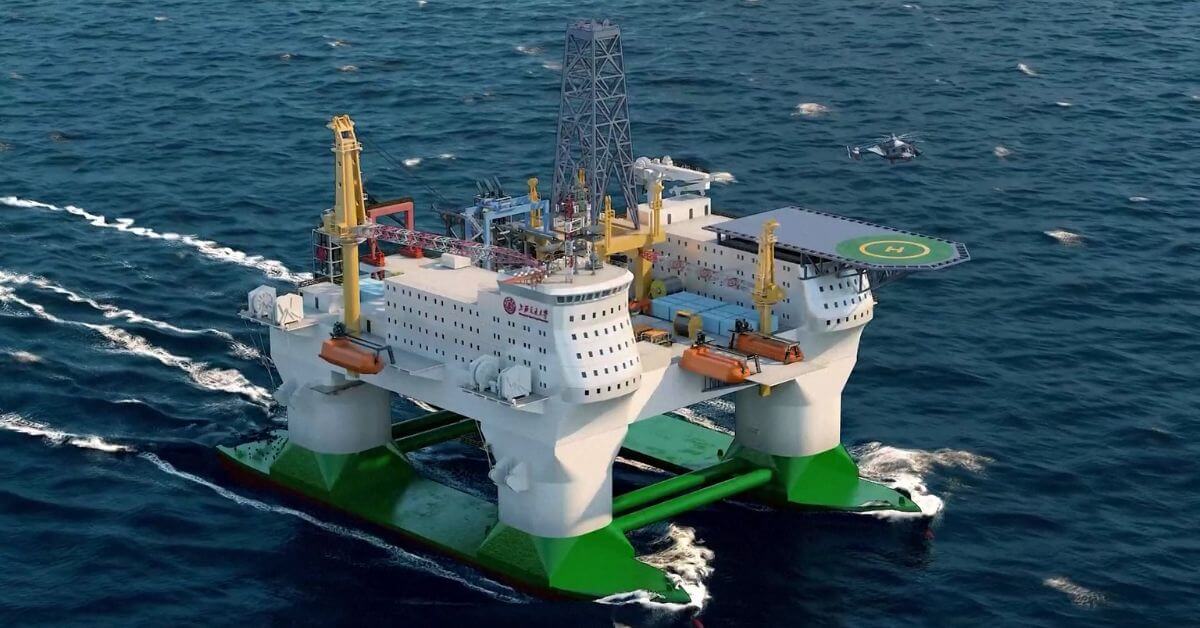
The platform, called the “Open-Sea Floating Island,” is described as the world’s first ultra-large marine research facility of its kind. It is designed to support work related to marine equipment, ocean resources, and marine science.
The facility is made up of three main parts: a central floating platform, ship-based laboratories, and shore-based support systems. These are meant to work together to allow scientists and engineers to carry out research both offshore and on land.
The main platform uses a semi-submersible twin-hull design, which helps keep it stable in rough seas. It can handle testing of deep-sea equipment weighing hundreds of tonnes and support research at ocean depths of up to 10,000 meters, or about 32,800 feet.
The structure is also built to withstand extreme weather. It can face strong waves and Level-17 typhoons, with wind speeds reaching around 250 km/h.
At the same time, it can move like a ship and then shift into a stable working position once it reaches a research site.
One of its key features is a large moon pool in the centre of the platform. This allows heavy equipment to be lowered directly into the sea.
The facility can deploy equipment weighing up to 300 tonnes to depths of around 6,000 meters, reaching areas where sunlight does not reach.
The overall size of the platform is said to be comparable to a medium-sized aircraft carrier, and its height is roughly equal to a 30-storey building. It is also designed to carry advanced scientific instruments for different types of ocean research.
The project is being developed by Shanghai Jiao Tong University, which has also set up a dedicated institute for deep-sea science and engineering to support the work.
The facility is expected to be completed by 2030. Once ready, it will be used as an open-sea testing ground for deep-sea mining systems, offshore oil and gas equipment, and other marine technologies.
It will allow testing in real ocean conditions instead of controlled environments near the shore.
According to Chinese reports, the platform will also support research on marine ecosystems, including how they change over time, and studies related to the origin and evolution of life in deep-sea environments.
It is also expected to help improve typhoon forecasting, which could support disaster preparedness in coastal areas.
References: globaltimes, cgtn
Want to read more?
Check out the full article on the original site